
LifeCycle Swim School
  • Locations
  • services
    • PRIVATE swim LESSONS
    • Lessons / Our Pools
    • Private swimming lessons at home >
      • Home pool safety Assessment
    • Baby Swim Lessons, Infant Survival Swim Classes
    • Kids Swim Classes
    • Swim Surge® Crash Course 2025
    • SwimFix
    • Teen swim lessons
    • Adult swim lessons
    • Special Needs Swim Lessons
    • Lifeguard Services
    • POOL PARTY PLANNING
    • Fear of Water Program >
      • aqua phobia facts
    • Water Safety Workshop
    • gift certificates
    • Online Courses
    • SHOP
  • fees
    • Indoor Pool Time Blocks
    • Indoor Pool Group Classes
    • Outdoor Pool-Montclair
    • Home/Private Pool
    • Lifeguard Services
    • Policies Overview
  • Register
    • Indoor Pool Time Blocks
    • Indoor Pool Group Lessons
    • Outdoor Pool-Montclair
    • Swim Surge® Crash Course 2025
    • Home Pool Lessons
    • waivers
    • recommendations for effective swim lessons
    • gift certificates
  • Teachers
  • about
    • Blog
    • Blue Space NJ Blog
    • Our Philosophy
    • Safer Sooner Method >
      • SAFETY CYCLE
      • BASIC WATER COMPETENCY
    • Youth Progressive Curriculum
    • small class sizes
    • Pay as You Swim
    • gift certificates
    • FAQ
    • Mailing List
    • Aquatic Partnerships
    • Water Safety Toolkit
  • 908-827-1669
    • contact
  • We're Hiring
  • Certification Lead
  • Certification Opt In grey
  • Locations
  • services
    • PRIVATE swim LESSONS
    • Lessons / Our Pools
    • Private swimming lessons at home >
      • Home pool safety Assessment
    • Baby Swim Lessons, Infant Survival Swim Classes
    • Kids Swim Classes
    • Swim Surge® Crash Course 2025
    • SwimFix
    • Teen swim lessons
    • Adult swim lessons
    • Special Needs Swim Lessons
    • Lifeguard Services
    • POOL PARTY PLANNING
    • Fear of Water Program >
      • aqua phobia facts
    • Water Safety Workshop
    • gift certificates
    • Online Courses
    • SHOP
  • fees
    • Indoor Pool Time Blocks
    • Indoor Pool Group Classes
    • Outdoor Pool-Montclair
    • Home/Private Pool
    • Lifeguard Services
    • Policies Overview
  • Register
    • Indoor Pool Time Blocks
    • Indoor Pool Group Lessons
    • Outdoor Pool-Montclair
    • Swim Surge® Crash Course 2025
    • Home Pool Lessons
    • waivers
    • recommendations for effective swim lessons
    • gift certificates
  • Teachers
  • about
    • Blog
    • Blue Space NJ Blog
    • Our Philosophy
    • Safer Sooner Method >
      • SAFETY CYCLE
      • BASIC WATER COMPETENCY
    • Youth Progressive Curriculum
    • small class sizes
    • Pay as You Swim
    • gift certificates
    • FAQ
    • Mailing List
    • Aquatic Partnerships
    • Water Safety Toolkit
  • 908-827-1669
    • contact
  • We're Hiring
  • Certification Lead
  • Certification Opt In grey

Blog

Be safe. have fun. stay fit.
​Montclair, NJ

Why Starting Swim Lessons Early Benefits Children

9/5/2025

0 Comments

 
Picture
All parents want to give children the best start in life—socially, emotionally, and physically. While most people think of swim lessons as primarily a way to keep kids safe around water, research shows the benefits reach beyond swimming skills. A landmark study by Griffith University in Australia followed more than 7,000 children under the age of five and uncovered something remarkable: early swim lessons help kids develop faster in key areas of life, not just in the pool. The benefits appeared even when researchers accounted for socioeconomic differences—meaning the positive effects came from the swim experience. It's no wonder the American Academy of Pediatrics recommends starting swim lessons at age 1.

Key Findings from the Study

  • Cognitive skills grow faster. Children ages 3–5 who took regular swim lessons scored higher in problem-solving, counting, and following instructions than their non-swimming peers.
  • Language develops sooner. Swimmers demonstrated stronger oral expression, listening, and understanding—skills that support school readiness.
  • Physical milestones come earlier. Kids who swam from a young age often showed better balance, coordination, and fine motor control. These skills support everything from running and climbing to handwriting.
  • Social and emotional confidence improves. Swimming provided opportunities for children to interact with teachers and peers, building trust, resilience, and independence.

Why Ages 1-3 Matter

The study highlighted the importance of starting young. Ages 1–3 are a critical window for brain development, and water activities stimulate both sides of the brain through movement, breath control, and sensory engagement. Early exposure reduces water-related anxiety and helps children feel comfortable around water—laying the foundation for successful swim lessons as their coordination capabilities expand.

How LifeCycle Swim School Supports your Child

At LifeCycle Swim School, we design our classes around these principles. Our Water with Me™ guardian-assisted classes for babies and toddlers combine skill-building activities disguised as play with meaningful bonding time. Through songs, games, and guided movement, children begin to:
  • Learn safe water habits
  • Build self-rescue techniques such as floating
  • Develop breath control
  • Develop coordination and motor patterns
  • Grow confidence while having fun with a trusted adult by their side
  • Gain social skills in a group environment

Our Sessions Blend Nurturing Guidance that Supports Water Safety and Whole Child Development

If your child is between ages 1 and 3, now is the perfect time to begin. Swim lessons offer more than peace of mind around water—they provide a rich, joyful learning environment that boosts your child’s physical, social, and cognitive growth.
The Griffith University study shows what we see every day at LifeCycle Swim School: children who swim early don’t just become safer swimmers—they become more confident, capable learners in every area of life.
Give your child the gift of confidence, safety, and early development. Enroll today and let’s start this journey together.
Register for a guardian-assisted baby / toddler swim class
Picture
Griffith University Researchers
0 Comments

Why We Don't Recommend Puddle Jumper™ Type Devices

5/28/2025

 
Picture
Many families use flotation devices like Puddle Jumpers™ for peace of mind at the pool, lake, or beach. While these colorful, U.S. Coast Guard (USCG) approved devices might seem like the perfect solution for keeping kids safe, we don't recommended them for children who are learning to swim. Experts in aquatic education warn that regular use of these devices can interfere with learning proper swim skills and water safety awareness.

Understanding How Puddle Jumpers™ Work
Puddle Jumpers™ are removable flotation aids with armband floats connected to a chest pad, and a rear buckle. They keep children vertical in the water, with the face out of the water, and they prevent sinking. Fitted and clasped properly, they stay on well and don't leak air since they're made from cellular foam.

Swimming Is Learned Horizontally, Not Vertically
To learn to swim children must develop comfort and floating in horizontal positions, lying flat on the belly with face in the water, and on the back, integrating coordinated arm and leg movements. Puddle Jumpers™, doing what they're designed to do, keep kids in a vertical position, which is a sinking position. Overuse of these devices trains muscles and reflexes to rely on a vertical position when they eventually try to swim without the device. If a child accidentally falls into water without flotation, they're more likely to seek the familiar, vertical position, not self-rescue positions like back floating or swimming back to the wall. 

Disruption of Swim Skill Development
Swim instructors report that children who frequently use Puddle Jumpers™ struggle with the essential foundational skills of breath control, floating, and basic propulsion. Children may resist putting their face in the water because they never had to while wearing the device. The bulky arm pads restrict arm movement, blocking arm stroke development. The devices also promote an underwater vertical kick, instead of a horizontal kick at the surface.

They Create a False Sense of Security / 70% of Drownings Happen During Non-swim Time
These devices, especially when children are allowed to float around the pool without a parent at arm’s distance, can give kids a false sense of security. Even worse, floating without an adult broadcasts to children that swimming is easy and can occur unsupervised. Rather than developing a healthy respect for water, kids can become too comfortable and even think it's safe to return to the water, alone and without the device. Children who use Puddle Jumpers™ can develop "false confidence," believing they can swim on their own. Puddle Jumpers™ also don't necessarily prevent unusual and potentially dangerous situations, like getting stuck behind a pool ladder. When a child is wearing a flotation device, or when providing hands-on assistance, never say, "You're swimming!" Instead, say, "You're learning to swim, and I need to be near you."

What Should Parents Use Instead?
In deep water, open water, or on boats, properly fitted U.S.C.G. life jackets are essential for safety. We recommend vest style jackets that don't restrict arm movement. Watch this video on how to select the right size and fit life jackets. When it comes to learning to swim, nothing replaces qualified instruction, touch-supervision, and progressive exposure to water and skills. During swim lessons or recreational swim time, children should be supported with hands-on guidance from an instructor or caregiver who promotes horizontal floating positions and effective arm and leg movements, not a flotation device that promotes vertical/drowning position, and restricts limb movements. No flotation devices are approved for learning to swim.

​
At LifeCycle Swim School we sometimes use a swim assist "backpack" to help transition kids to swimming independently on their belly. These devices are not "approved" by anybody. We've found them useful because they allow children to put their heads in the water, provide a buoyancy boost and let kids practice arm and leg propulsion "independently" when they say, "I don't want you to hold me." Teachers stay right next to them, ready to provide hands-on assist if necessary. Never leave a child out of arm's reach when using any type of swim assist flotation.

All that said, sometimes guardians are outnumbered in a pool and it could make sense to have support from flotation devices. Follow these guidelines for recreational use of flotation devices in swimming pools for non-swimmers:
1. Use USCG certified vest style jackets that don’t impede arm movement.
2. Caregiver should remain arm's distance from any child in a life vest. 
Do NOT let children float around in a life vest without a guardian at arm's reach.
3. Give children equal time in a life vest and in no vest with hands-on touch support. The child’s experience will be more balanced, and he/she will be less likely to develop the bad habits promoted by a constant vertical position. Use the vest as a "one-off," rather than regularly.


Conclusion
While Puddle Jumpers™ may offer a feeling of security and make a guardian’s day easier, they can ultimately delay or even harm a child’s ability to learn to swim safely and effectively. Parents should prioritize swim readiness and skill development over convenience. Giving a child a foundation in proper swim technique early sets them up for a lifetime of confidence, safety, and enjoyment in the water. At LifeCycle Swim School, we teach parents how to support children in the water so they can continue skill development between lessons.

Finally, here's a story written by a mom who lost a child to drowning who believes use of a Puddle Jumper™ may have contributed to the tragedy.
Picture
U.S.Coast Guard Certified Life Vest
Picture
Swim assist "backpack"

Water-Safe Summer Planning Toolkit: Post #1

2/14/2024

 
Picture
Ahhh…summer…Sitting by a pool, reading, sipping an iced tea. For some it’s more like “How will I entertain the kids all day?” “Camp costs what?!” and “I can join that video call from the car - after camp drop-off.” Making summer even more stressful is that undercurrent of worry that our kids stay safe around water.
Read these six tips to get your safe summer started.

1. Think ahead about any vacation days, and book hotels now.
  • Confirm the days off from work. Communicate your summer schedule to colleagues and direct reports.
  • If vacationing around waterscapes is a priority, start researching hotels (see point #2) and book now. Waterscape properties are always in high demand.
  • Camp drop-offs and pick-ups can mess with your schedule. Meet with your manager to discuss any flexibility you'll need over the summer. Join with other parents to help convince management.
  • Make arrangements for pets, house plants, yard and pool.

2. Consider water safety when researching hotel properties, rentals, and any water excursions.
  • If you're considering any overnight stays at properties that have water features or are near waterscapes, here's a list of water safety questions to consider or ask.
  • If you're staying at friends' or family's property that has a pool or access to any open water, ask about water barriers like pool fences or covers, and on-site rescue equipment. If any repairs, installation or purchases are needed, start making arrangements now.
  • When planning water excursions, be mindful of your family's water skills. Don't book excursions that are too advanced. Base water activity decisions on ability, not age.

3. Refresh your CPR skills.
One of the five layers of protection for being safe around water is having an emergency action plan - which includes knowing CPR. If it's been a while since you've practiced, take a refresher course. Here's the link to Red Cross classes.​

4. Make sure all caregivers watching children in and around water have the proper skills and certifications.
  • Only people who know how to swim should be responsible for watching children in, on and around water. Know the swimming abilities of your caregiver. Be wary that some people overestimate their swimming skills. Ask direct, specific questions about swimming skills and encourage them to be honest.
  • Ensure that any caregiver watching your children around water has refreshed CPR/rescue breath skills.

5. Follow these for choosing camps with swim programs.​
  • If you want a camp to provide swim lessons, research the swim program to be sure it's a good fit. Call the camp and ask questions (download this guide from the National Drowning Prevention Association). Talk to parents whose kids have attended and ask specific questions about the program.
  • If the camp doesn't provide swim lessons, ask if there are any water features on or near their property, and how the children are supervised around the water.
  • Getting kids to and from camp can be draining, consider arranging a carpool.
  • Get the scoop on camps by asking friends or posting on social media.
  • Use local resources like Mommy Poppins/NJ and Macaroni Kid

6. Build swim lessons into your summer plans.
If your child doesn't take year-round swim lessons, summer is the time to progress their skills in sync with age, maturity and physical growth. Basic swimming is a life skill that everyone should have. If you have a resistant kid, push gently forward and call us for tips! Research programs and choose a reputable school that fits your schedule. Download this swim lesson checklist from the National Drowning Prevention Association. Swim programs in our area often have waiting lists, so register now.  You can register for our swim programs here.
Register for our swim programs

Be Water Safe During Spring Break

3/14/2023

 
Picture

​As families prepare for spring break adventures, LifeCycle Swim School wants parents and caregivers to have all the knowledge they need to ensure a water-safe vacation. Drowning is the leading cause of death for children between ages 1-4, and the second leading cause of death between ages 5-14. Being in an unfamiliar environment - such as a hotel, AirBnB, water park or beach could contribute to unsafe circumstances and lax protocols.

​Drowning is silent. 
Someone struggling in the water may not yell for help, wave their arms, or thrash around. It’s critical to always provide constant, vigilant supervision when children are around any type of water environment.
The CDC lists the following factors that can make drowning more likely, and these factors are likely heightened during vacations and when an environment is new or not visited often.
  • Inability to swim.
  • Missing or ineffective fences around water.
  • Lack of close supervision.
  • Not wearing life jackets.

Tips to Help Keep Your Family Water Safe During Vacation
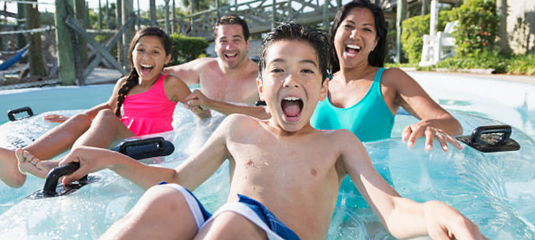
  • Familiarize yourself with the pool, beach, or any water features in the area where you're staying - including bathtubs. Understand what safety measures are in place such as lifeguard hours, gates, fences, rescue equipment, or the lack of these safety measures.
  • Constant, vigilant caregiver supervision around water is essential.
  • If your destination has lifeguards, schedule swimming during lifeguard hours. That said, Lifeguards are not babysitters. Caregivers must engage in constant, vigilant supervision.
  • Designate a Water Watcher, an adult in your group who keeps a close eye on swimmers. Rotate the Water Watcher every 30 minutes to avoid supervision fatigue.
  • Review the water rules with your family, and avoid letting these rules fall by the wayside as you relax. The number one rule: require that any child under your care ask permission before getting near the edge of any water.
  • When boating, everyone should wear a U.S. Coast Guard Certified life jacket. A properly fitting life jacket fits snug, and stays under a child’s chin when they lift their arms overhead. Click here to watch a quick video on how to fit a lifejacket.
  • Implement a buddy system. Nobody should swim alone - including adults - and no one is drown proof, even if they are a proficient swimmer or wearing a life jacket. Buddys can seek help if something is wrong.
  • Prepare for vacations by enrolling in formal swim lessons. The CDC notes that swim lessons reduce drowning by 88%, making year-round swim lessons a great way to help a child be safe around the water.
Picture

    Jennifer May

    Swim ambassador of Montclair, NJ.

    Archives

    October 2025
    September 2025
    August 2025
    July 2025
    June 2025
    May 2025
    December 2024
    February 2024
    January 2024
    December 2023
    May 2023
    March 2023
    February 2017

    Categories

    All
    Adaptive Swim Lessons
    Baby Swim Programs
    Child Development
    Flotation Devices
    Growth Mindset
    Learning
    Life Jackets
    Parent Resources
    Puddle Jumper
    Safety
    Science Of Swimming
    Special Needs
    Spring Break
    Summer
    Summer Vacation
    Swim Safety And Education
    Teachers
    Toddler And Preschool Programs
    Vacation

    RSS Feed

Lifecycle swimming    908-827-1669

Premium swim instruction dedicated to accelerated progress


Info

About
Locations
​Teachers
​
Youth Curriculum
Safer Sooner™
FAQ
Fees
​
Policies

services

All Services
​
Private Lessons
​
Adult Lessons
Home Pool Instruction
Lifeguard Services
Fear of Water Program
Shop

register

Book a Lesson / Our Pool
Book a Lesson / Your Pool

908-827-1669

Email
Blog

Leave us a review on

Picture
Picture
Your reviews help us grow and improve.
​Thank you!
* indicates required
/* real people should not fill this in and expect good things - do not remove this or risk form bot signups */

Intuit Mailchimp


Copyright 2016-2019 Lifecycle Aquatics, LLC.  All rights reserved.
Content on this site is for informational or educational use, and should not be construed as medical or insurance advice.  Lifecycle Aquatics, LLC provides general information about swimming and water safety.